Van Wrap vs Cut Vinyl | Which Livery Pays Off
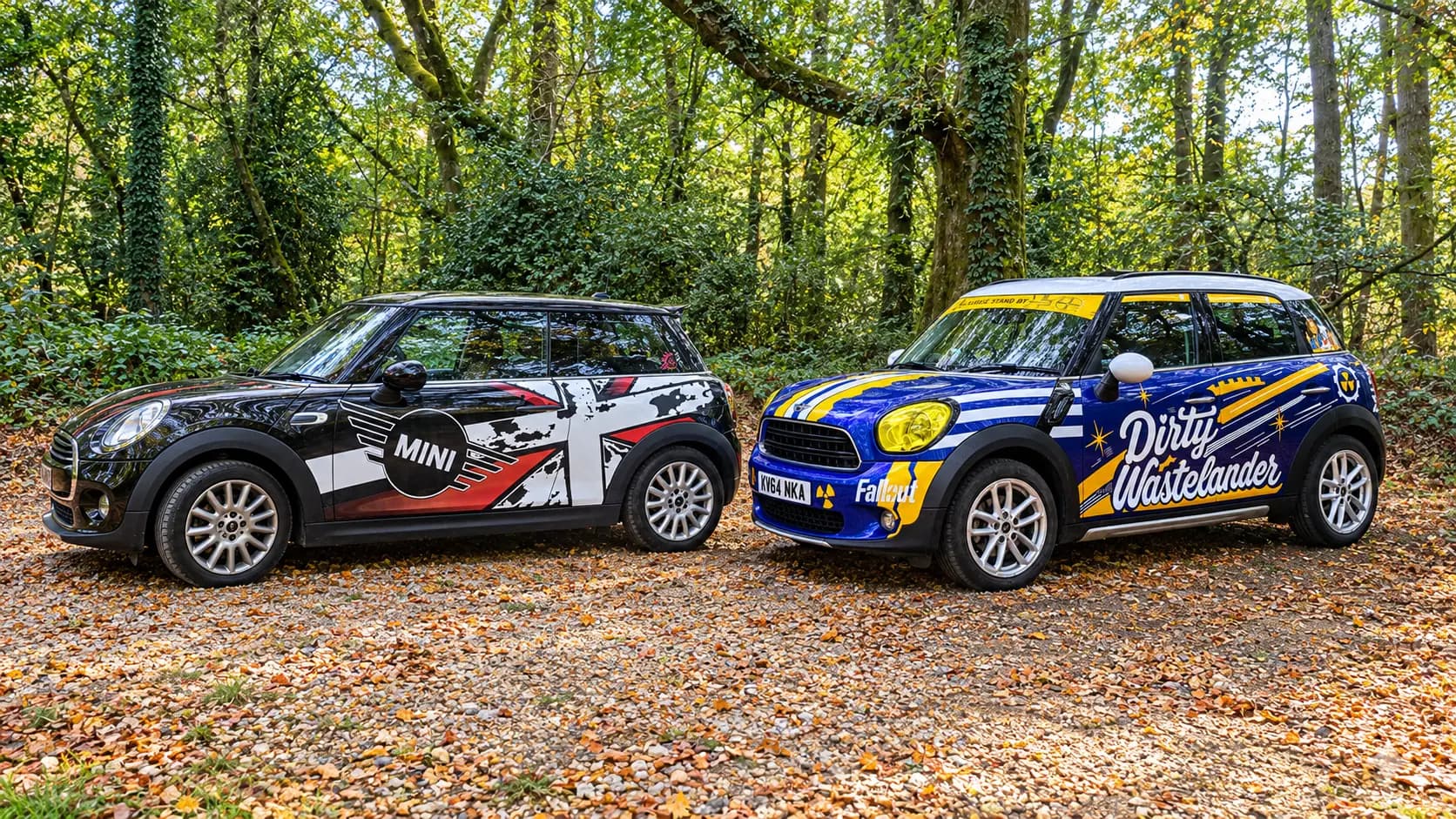
Hannah and Mandy, in the office, have been playing with cut vinyl for their Minis. This got us thinking about full wrap, part wrap or cut vinyl: how much it costs, downtime, film type and lease returns decide it.
You've got a white Transit on the drive doing nothing for you, and three quotes in your inbox that are wildly different numbers for what looks like the same job. That gap isn't the sign writer having you on.
Full wrap, part wrap and cut vinyl are genuinely different products. They suit different vans, different mileages and different exit plans, and the right one usually falls out of two or three practical questions rather than a taste decision. Here's how we talk clients through it.
What each one actually is
Cut vinyl is solid colour film, plotted into shapes and letters, weeded by hand and applied panel by panel. No printing involved. Your logo, phone number, web address and a couple of service lines, in two or three colours, sitting on the van's existing paint.
A part wrap is printed vinyl over the rear doors, the lower sides and often the bonnet-to-shoulder line, with the roof and upper panels left as factory paint. Printed imagery, gradients, photography, whatever you like, over roughly a third to two thirds of the vehicle.
A full wrap is printed and laminated cast film over every visible panel, round the door shuts, into the recesses, over the bumpers if you want it. The van's original colour stops mattering, which is the whole point: a deep blue wrap on a white van reads as a deep blue vehicle from fifty metres away.
The things that actually decide it
| Cut vinyl | Part wrap | Full wrap | |
|---|---|---|---|
| Relative cost per van | Lowest | Higher, and it tracks the printed area | Highest, and the gap widens with van size and how many recesses need conforming |
| Off the road | Part of a day | Around a day | Two days is normal, longer on a high-roof LWB |
| Vertical panels | Cast solid colour holds up well past five years | Around five years with a good laminate | Around five years with a good laminate |
| Bonnet and roof | Rarely graphics up there anyway | Fade and laminate chalking show first, often by year three | Same, and the roof is the first thing a leasing inspector photographs |
| Lease return | Quick removal, low risk | Low risk, more labour | Most labour, but the paint underneath usually comes back clean |
| Design freedom | Flat colour and shapes only | Printed imagery on chosen panels | Total |
The lifespan rows are where the cheap quotes catch people out, so it's worth being blunt about film. Monomeric calendared vinyl is made by extruding and rolling the material out under tension, and it keeps the memory of that stretch. Warm it on a curved panel and it wants to shrink back towards the shape it was made in, which is why you see lifted edges and shrink lines around recesses. Cast film is poured as a liquid onto a casting sheet and cured flat, so it goes on with almost no built-in stress and stays where you put it. What lifts a cheap wrap early is UV and the daily heat cycling of a metal panel in sun, not frost. A van baking outside a site office all summer ages faster than one that lives in Aberdeen.
New vans have to cure first
If the vans are brand new or freshly resprayed, the paint needs time to gas off before film goes near it, and dealer PDI wax has to come off properly. Build that into the schedule rather than booking the wrap for the afternoon the van is collected.
Chapter 8, if the van works roadside
Groundworkers, utilities and anyone parking on a live carriageway will need rear chevrons in the right red and yellow reflective grades. Reflective film can't sit under a wrap, so the chevrons go on last, over the top, and they eat the rear doors. Design the livery around that from the start or you'll lose your phone number to a chevron block.
For a two-van trade business, go cut vinyl
Sorry to the wrappers, but for a plumber, electrician or small building firm running two white vans, cut vinyl in cast film wins on nearly everything that matters to you. Same phone number in front of the same number of people on the school run. It's the cheapest route to getting both vans done at once rather than one now and one "next year". It survives a lease return without drama. And when someone reverses into the rear door at a builders merchant, you're replacing one panel of letters instead of trying to match a printed graphic across a join.
Here's the catch, and it's the one clients are most surprised by. Cast solid colour ranges are finite. A few hundred swatches, not a Pantone book, so a fussy brand colour often has to go to the nearest available film, or be printed and contour cut instead, which brings back print costs on a small area. Bring us the brand colour early and we'll tell you honestly whether the match is close enough to live with.
Design discipline matters more than the process here. Two colours, a logo, one service line, one number, all sized to be read at thirty metres. Fussy cut vinyl looks cheaper than simple cut vinyl.
Where a full wrap earns its money
When the vehicle is the advertising budget. A holiday park's grounds vehicles doing laps in front of guests all season, a dog groomer parked outside the same house for an hour, a coffee conversion, a fleet where the colour itself is the brand. If you need photography, a dark base or artwork that flows across panels, printing is the only way to get there, and a part wrap will look like it ran out of money halfway up the side. The other honest case is a long-owned fleet: keep the van seven years, wrap it in laminated cast film, and the paint underneath is protected the whole time.
Send over the van make, model and wheelbase with your logo files, and we'll show you the same brand as cut vinyl and as a full wrap before you commit to either.
Got a project like this?
Send the brief or the artwork over and we'll tell you honestly what we'd do with it.
Talk to Us