Outdoor Print Lifespan | How Long It Really Lasts
Honest outdoor print lifespans for PVC banners, mesh, Correx, Foamex, Dibond and vinyl in UK weather, plus what shortens them and how to brief it.
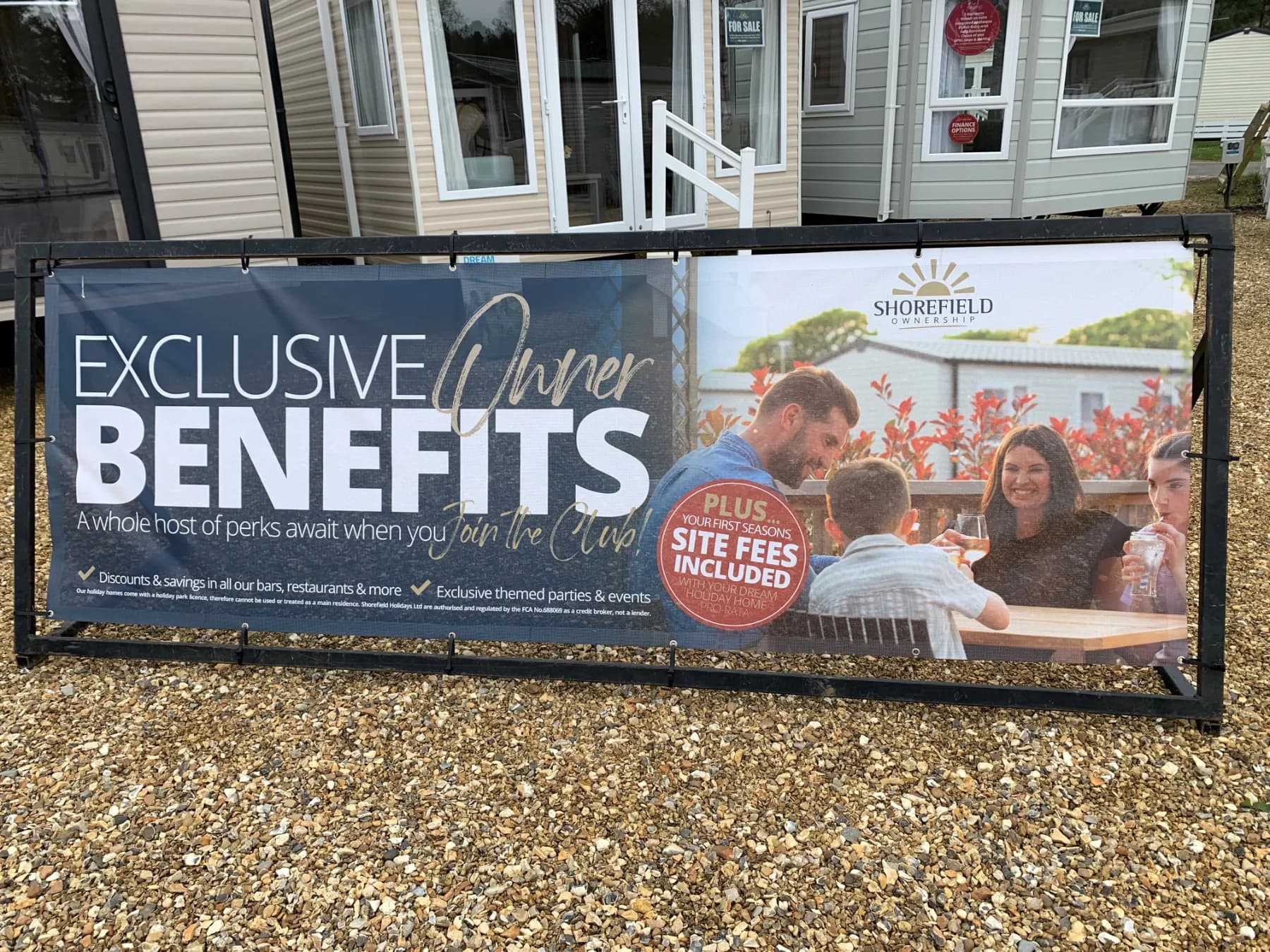
Most outdoor print doesn't die of old age. It gets killed early, usually by something cheap and avoidable: a cable tie threaded through a hem, a laminate skipped to save a few quid, or a south-facing wall that bleaches a magenta down to pink by August.
So when a client asks how long does outdoor printing last, the honest answer is a range. Where you land in that range is mostly down to the spec you brief and the way the thing goes up on site. Two identical banners, same roll, same inks, can be eighteen months apart in useful life purely because one was fitted with bungees and one was strangled with ties.
Here's what we actually see come back through the door.
Material versus realistic life outdoors
UK figures, assuming decent UV-cure or latex output and a sensible installation. Coastal sites in Dorset, Devon and Cornwall sit at the lower end of every row. Salt, wind-driven grit and open sky do not care what you paid.
| Material | Typical spec | Realistic outdoor life | What drags it down |
|---|---|---|---|
| PVC banner | 440-510gsm, welded hems, eyelets at 500mm | 1-3 years | Cable ties, no hem, flapping, undersized for the frame |
| Mesh banner | 270-340gsm, 70/30 mesh | 1-2 years | Fraying corners, scaffold rub, repeated take-down |
| Correx | 4mm fluted | 12-24 months, or 6-12 on exposed roadside | Flute direction wrong, UV chalking, snapped at the stake |
| Foamex | 3mm or 5mm PVC foam | 2-4 years | Thermal bowing on long panels, no laminate on a south elevation |
| Dibond (ACM) | 3mm aluminium composite | 5-10 years | Edge corrosion at the coast, cheap film applied to it |
| Cast vinyl + UV laminate | 50 micron cast | 5-7 years | Poor surface prep, applying below 10 degrees |
| Polymeric vinyl + laminate | 75-80 micron calendered | 3-5 years | Deep recesses, sharp compound curves |
| Monomeric vinyl | 100 micron calendered | 1-2 years | Shrinkage, lifting edges, rivets and curves |
| Window graphic | Optically clear or one-way vision | 2-3 years | South-facing glass, heat build-up, jet-washing |
The Correx figure is the one people argue with. A 4mm board on a north-facing fence behind a hedge will give you two seasons without complaint. The same board staked at a roundabout, facing south, taking spray off the road, chalks and goes brittle far quicker. Both numbers are in the table because both are true.
Notice the spread elsewhere too. A banner can genuinely last three seasons or be binned by October, and the material is identical in both cases.
Monomeric, polymeric or cast
This is the distinction that costs clients money, so it's worth being blunt about it.
Monomeric film is cheap, it's thick, and it wants to shrink back to the size it was before it was stretched. Flat panel, short life, fine. Put it on a curve, over rivets, or into a recess and you'll see the edges lift inside a year. Polymeric is the sensible middle: around 75-80 micron, far more stable, happy on gentle curves and vehicle flanks, and good for three to five years with a laminate over it. Cast at 50 micron is the thin, conformable one that goes where the shape is awkward and stays put for five years plus. Most clients are quoted monomeric when they should be offered polymeric. If a wrap or a long-term sign comes in at a surprisingly low number, that's usually why.
Four things that actually shorten life
Cable ties through the print. You'll know this one. Someone orders a banner with eyelets every 500mm, the installer runs out of bungees, and the ties go straight through the hem and get yanked tight. Wind does the rest. A few weeks later there's a tear running from the eyelet to the edge. Bungee loops spread the load; ties concentrate it into one point.
No laminate on a long-term graphic. On a six-week promotion, skip it happily. On anything that still needs to look like your brand colours in eighteen months, a UV laminate is the cheapest insurance going. A holiday park operator in the south west had two runs of 5mm direct-printed Foamex go out for the same wayfinding scheme, one laminated and one not, three months apart. At fourteen months the unlaminated panels had gone chalky and the red in the logo had dropped to a dull orange; the laminated set from the earlier batch still matched the proof. They replaced the lot in laminated Foamex and now laminate anything that stays up past one season.
South-facing fade. Reds and magentas go first, then warm oranges. Corporate blues and blacks hold up far better. If your brand is built on a deep red and the sign faces south across open ground with no shade, you're on a shorter clock than the table suggests. Build the replacement into the budget, or design so the red isn't the whole panel.
Undersizing. A banner cut to the exact internal size of a frame has nothing to tension against, so it ripples, and a rippling banner works itself loose and frays at the eyelets. Measure the frame and send us the figures before anything gets cut.
Coastal is its own category
Salt air pits unprotected aluminium edges and carries fine abrasive grit that scours print surfaces on exposed elevations. A park on a clifftop will get noticeably less out of the same spec than a client ten miles inland. That's normal, not a fault.
What helps: laminate everything, choose Dibond over Foamex for anything permanent, and wash panels down with clean water once or twice a year. Plain water, soft cloth. Not a jet wash, which will find any slightly lifted vinyl edge and peel it like a sticker.
Where spending more pays back
- Polymeric or cast film instead of monomeric on anything curved, riveted or expected past two years
- UV laminate on any graphic staying up beyond one season
- Dibond rather than 5mm Foamex for permanent external signage, especially long horizontal panels that bow in heat
- Welded hems with eyelets at 500mm centres on anything over 2m wide
And where it doesn't: premium long-life media on a dated event banner, 5mm Correx when 4mm covers a six-week site board, 650gsm blockout PVC when there's nothing behind the banner to block out, or anti-graffiti laminate on a panel three metres up a wall.
That last one catches people out. Someone specs the full protective build on a sign nobody can reach, then leaves the laminate off the one at eye level by the entrance. Spend the money where hands and sunlight are.
Artwork and hems, properly
Resolution first: 100-150dpi at full size is plenty for anything viewed from more than a couple of metres, and files well above that just slow the rip down for no visible gain.
Hems are where supplied artwork goes wrong most often. Bleed and hem allowance are two different things. Bleed is 25mm of artwork past the trim so there's no white sliver on the edge. A welded hem folds material back on itself, and that needs 50-75mm of extra material per hemmed edge on top of the bleed, with background colour carried through it. Get that wrong and the banner either comes back short of your finished size or the hem folds a strip of your logo out of sight. Keep live text and phone numbers at least 75mm inside the trim as well, so an eyelet doesn't land in the middle of them. It has happened.
How to brief it
Tell us these up front and we can spec it right first time:
- How long it needs to live, in months
- Where it's going: wall, fence, frame, posts, scaffold, glass
- Which way it faces, and whether anything shades it
- Distance from the sea
- Exact frame or aperture sizes, measured rather than estimated
- Whether it comes down and goes back up seasonally
Number six matters more than people expect. Seasonal graphics that get rolled, shoved in a damp container over winter and rehung every spring need a tougher build than something that goes up once and stays there. Roll them printed side out, in a tube, somewhere dry.
Send over your artwork or a rough brief with the site details and we'll tell you honestly what spec it needs, and what you can safely leave off.
Got a project like this?
Send the brief or the artwork over and we'll tell you honestly what we'd do with it.
Talk to Us