Site Hoarding Design | Make the Fence Sell Plots
Practical advice on hoarding panel layout, substrates, artwork scale and readable type, so the fence around your site works as a sales tool.
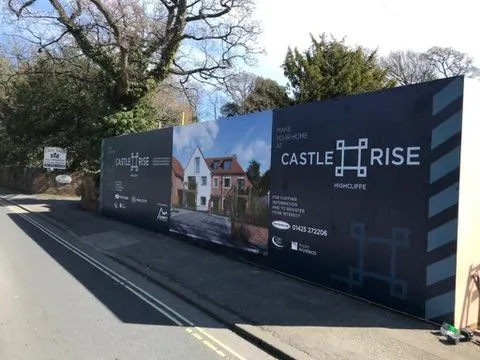
You've got 60 metres of 2.4m plywood around a 42 plot development, the logo is on it four times, and the only thing anyone reads is the "Danger, hard hats" notice. The sales office sits back behind the compound where nobody driving past will ever spot it.
That hoarding is the biggest piece of advertising the site will ever have. It's already paid for. Most of it is doing nothing.
The causes are dull rather than dramatic. Artwork gets briefed late, after the fencing contractor has set the posts, so the design has to be squeezed into whatever bay widths happen to exist. Or a brochure PDF gets scaled to 2400mm and the CGI goes soft as porridge. Or it all goes up beautifully and six months later the corners are lifting, because the vinyl went onto ply that was still damp from the lorry. All fixable, and a decent chunk of it by you, before a printer is anywhere near it.
Decide what the hoarding is actually for
A hoarding has several jobs and they don't all want the same treatment. Plot sales want the street scene CGI, a call to action and an easy route to the website. The planning condition might want a heritage panel or a local wildlife graphic. Site operations want gate numbers, delivery hours and a visitors' entrance arrow. Trade recruitment deserves a panel of its own, and it works, because the people who read hoardings closely tend to be the people who work on them. The mistake is treating all 60 metres as one continuous roll of wallpaper. Split it by audience and by where feet and tyres actually are. The stretch along the main road is read at 30mph through a windscreen, so it gets two things: the development name and the web address. The stretch by the pedestrian crossing is read at walking pace for twenty seconds, and that's where the CGI, the plot mix and the QR code belong.
Type size follows from that. Our rough working rule is 100mm cap height for comfortable reading at 30m, and around 25mm at 7 or 8m. So the development name on the road run probably wants to be 400mm tall or more. A sentence of body copy set at 40mm is decoration rather than information, and we'd rather talk you out of it than print it.
The one thing to settle before anyone opens Illustrator
Get the bay centres and fixing positions marked on a drawing.
Set the panels out before you design them
Standard timber hoarding is 18mm ply on a stud frame, and ply comes in 2440 x 1220 sheets. The usual build is two 1220 sheets stacked landscape to give a 2.4m height, on posts at somewhere between 1.2m and 2.4m centres with horizontal rails top, middle and bottom. Which means you have a horizontal joint line running the whole way along at mid-height, plus a vertical joint every 1220mm, plus posts and capping rail on top of that. Site conditions throw in odd widths at corners, gates and returns as well. Design a single continuous 60m image in ignorance of all that and the installer will end up chopping a word in half across a post.
Two zones to keep clear:
- The bottom 300mm. It gets splashed, kicked, leaned on by pallets and plastered in mud by February. Nothing readable goes there.
- A 75mm margin either side of every post line, and off the mid-height rail if the panels are being fixed in two courses.
Keep the top 400mm free of fiddly detail where the run steps up sloping ground, because your horizon line will step with it. A full-bleed sky forgives that happily. A long horizontal strapline does not, and you'll see the stagger from across the road.
Supplying artwork that stays sharp at 2.4 metres
Build at 1:10 in CMYK with 10mm bleed, so a 2440mm panel becomes a 244mm document. Raster images want around 300dpi at that 1:10 scale, which is roughly 30dpi at full size. Say that number out loud when you're comparing quotes, because if a supplier insists on 150dpi at full size they're asking for five times the resolution and a file nobody can open, for a graphic read from eight metres away. At 2.44m wide, 300dpi at 1:10 means a CGI around 2900px across. Shared across three bays as a panorama, that's 8700px, and this is precisely where a render commissioned for a brochure falls apart.
Ask your CGI studio for the large format version at the point you commission the images. Going back eighteen months later to find the artist has archived the scene and moved studio is a miserable conversation.
On colour, send Pantone references for the brand palette rather than hex codes pulled off the website. Hoardings go up in phases as a site extends, sometimes with six months between them, and a flat brand blue is the one colour everybody notices drifting. We proof against the reference each time. Big solid areas are also where banding shows first, so a deep corporate navy across a whole 2.4m panel needs more watching than a photographic scene does.
Substrate and finish, honestly
| Build | Suits | Realistic life | What to know |
|---|---|---|---|
| Printed vinyl laminated onto 18mm ply | Long perimeter runs, the main road frontage | 12 to 36 months | Apply dry, clean and above about 10C. The bigger failure cause is ply moisture: fresh sheets off a wet lorry want time under cover before anything gets stuck to them, or you'll see corners lift by spring |
| Direct-printed 5mm Foamex or 4mm twinwall Correx, fixed to the ply | Phased plots, release panels, anything you'll swap | Correx 6 to 12 months before UV fade bites, Foamex around 2 years | Swap one bay when the plot mix changes instead of resurfacing 20m. Correx flutes show as fine lines on close-up solid colour |
| Printed mesh banner on Heras fencing | Windy, exposed plots and temporary lines | 12 to 24 months | Mesh fails at the edges, not the middle. Specify welded hems with webbing reinforcement and eyelets at 300 to 500mm centres, then fix with bungees so it can move. Cable ties pulled tight tear the corner eyelets out in the first gale |
| 3mm aluminium composite panel | Sales office frontage, entrance feature, longer-term boards | 3 years plus | Flat, rigid, takes a crisp cut vinyl logo. It also unscrews, and ACM walks off urban sites, so use security fixings or keep it inside the compound line |
Most developments end up with a mix. Vinyl on ply along the road, a handful of swappable boards for the plots currently released, and something better finished at the sales entrance, where a buyer forms a first opinion about the quality of your houses before they've seen one.
Anti-graffiti laminate is worth a sentence of its own, because there are two sorts and people buy the wrong one. Sacrificial laminate comes off with the tag and has to be reapplied afterwards, which suits a site with an occasional problem. Permanent laminate stays put and lets a contractor wipe solvent-based paint off repeatedly without dulling the print. On an urban street frontage with a known tagging issue, the permanent film usually saves you a reprint. On a quiet rural edge, it's money you didn't need to spend.
Where bringing us in early saves you a reprint
Setting out, if the fencing is already up and nobody measured it properly. Phasing, where the hoarding appears in sections across eighteen months and has to match panel for panel. And the scale-up itself, because resampling a brochure CGI to 2.4m has a visible ceiling, and we'd rather tell you you've hit it than print something that looks soft from the pavement.
Raise the planning question early too. We've seen hoarding designs signed off internally and then redrawn because the case officer wanted a specific heritage image on the gable end. Much cheaper to know that in week one.
Timing is the other one. Hoarding goes up at the very start of the programme, which is also the week the sales launch collateral, site boards and flag poles are all being argued about in the same meeting. Start the hoarding brief before groundworks and it goes on the fence looking planned. Leave it until the fence is standing and it becomes a logo, a phone number and a great deal of blue.
If you've got a site drawing, a CGI and a rough idea of what the hoarding needs to say, send it over. We'll mark up the panel layout against the bay centres and tell you honestly whether the imagery holds at size.
Got a project like this?
Send the brief or the artwork over and we'll tell you honestly what we'd do with it.
Talk to Us